Drive-in and push-back racking are both high-density storage solutions to help warehouses make better use of available space. While they have similarities, they operate in different ways and are suited to different types of stock and workflows.
Here’s your ultimate guide for how each system works, the benefits of each and the differences to consider when deciding on the right system.
The Difference Between Push-Back and Drive-In Racking Systems
Both systems increase storage by reducing aisle space, but the way pallets are accessed and moved is the key difference.
- Drive-in racking focuses on deep, compact storage, where forklifts drive into the structure itself
- Push-back racking uses a sliding system where new pallets effectively push existing ones back, using gravity to bring pallets to the front
Drive-in Pallet Racking
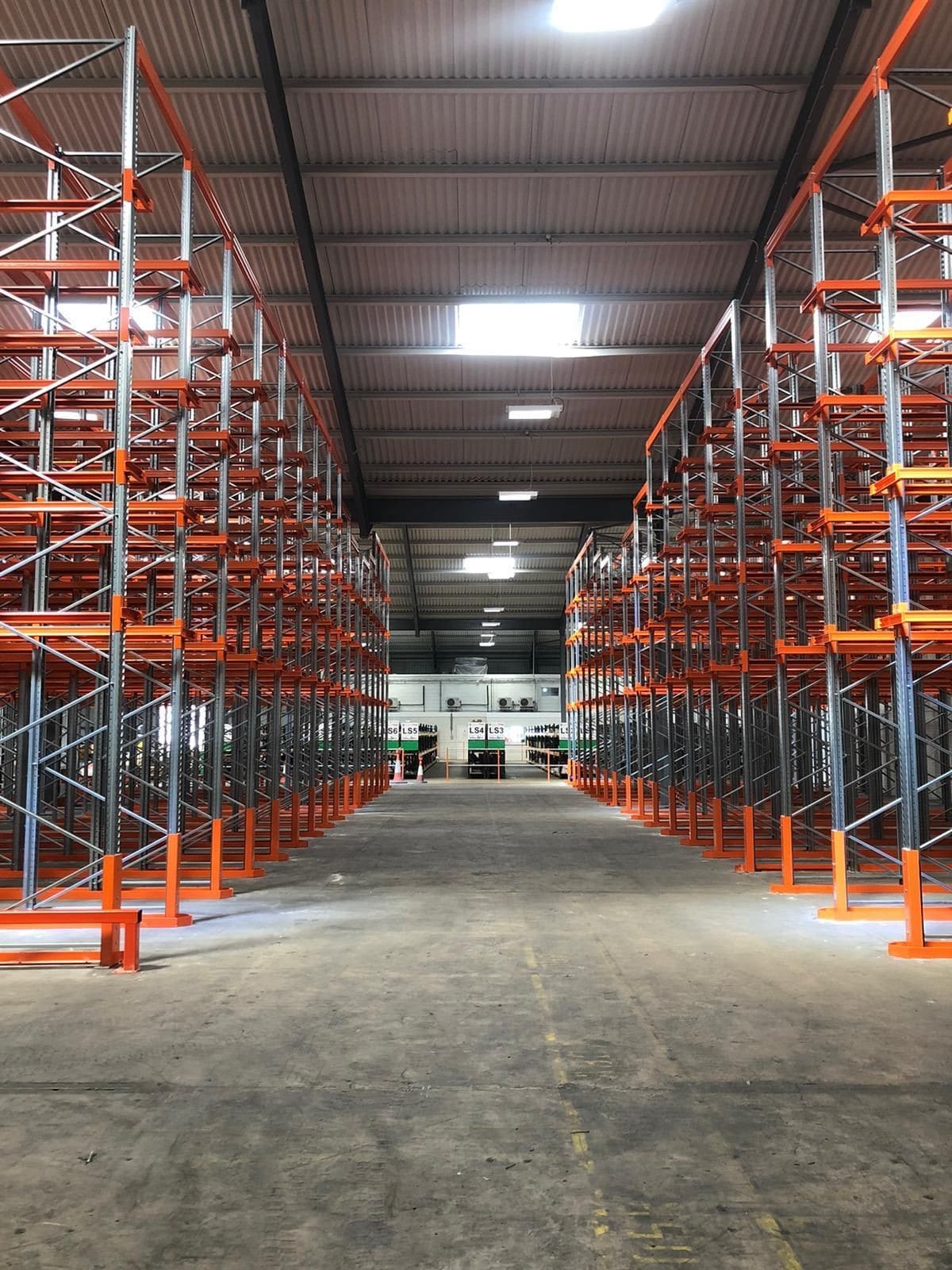
Drive-in racking is the most widely used racking system. It’s built for high-density storage where businesses want to make the most out of all available space. Forklifts drive directly into the racking system, placing pallets onto rails that form deep storage lanes in parallel lines.
This makes it ideal for warehouses storing large volumes of the same product. Because pallets are stored one behind the other, it’s a very space-efficient solution, especially in environments where stock turnover is low.
Key features of drive-in racking systems include:
- Forklifts enter the racking structure to load and retrieve pallets
- Deep lanes allow for bulk storage of identical goods
- Maximises vertical and floor space
- Typically operates on a last-in, first-out (LIFO) basis
The main limitation is access. Since forklifts must enter the system, it’s less flexible for frequent stock changes or mixed inventory.
Push-Back Racking
Push-back racking also focuses on saving space, but it works in a more controlled way. Instead of driving into the system, pallets are loaded from a single aisle onto wheeled carts that push each other back. This method can usually offer more storage than a drive-in pallet system.
As new pallets are added, they gently push existing ones back into the system. When a pallet is removed, everything behind it moves forward automatically, keeping access simple and organised.
Key features of push-back racking include:
- Pallets stored 2–6 deep on inclined rails
- All loading and unloading is done from one aisle
- Uses a last-in, first-out system
- Reduces forklift travel within the racking
Benefits of Drive-in Racking
The main benefit of drive-in racking is that it makes efficient use of the floor surface area, plus vertical space. Other benefits of drive-in racking systems include:
- Reduced travel time as drivers can access multiple product lanes from one aisle
- Stores large volumes of similar products that don’t benefit from a first-in-first-out (FIFO) system
- Maximises storage capacity for large quantities
- Removes the need for multiple aisles
- More cost-effective solution for bulk storage operations
- Easy to expand with more tiers as business needs grow
Where Can Drive-in Racking Be Used?
Drive-in racking is commonly used in environments where stock doesn’t need to be accessed frequently or rotated in a specific order. It’s a great choice for a stable, predictable inventory.
This system is widely used in industries where high-volume, low-variety storage is required. Typical applications include:
- Manufacturing facilities storing raw materials or finished goods
- Cold storage warehouses where space is at a premium
- Automotive environments such as tyre storage or seasonal parts
Benefits of Push-Back Pallet Racking
Compared to drive-in systems, push-back racking is generally quicker to operate and offers better control over stock movement. It also offers other benefits, including:
- Makes excellent use of space, especially vertical space
- Requires little to no maintenance compared to standard selective racks
- Needs little forklift movement as the racking does the work
- Provides a more controlled system for managing stock
- Ensures safer handling of goods
This method is often chosen by businesses that want high-density storage without sacrificing speed or ease of access.
Where Can Push-Back Racking Be Used?
Push-back systems are commonly used in fast-moving environments where efficiency matters. This includes:
- Food and beverage storage
- High-volume distribution centres
- Automotive and construction, where multiple product types need to be stored correctly
Considerations for Push-Back and Drive-in Racking
While both systems are excellent for making the best use of space within a warehouse, they do come with different trade-offs.
- Drive-in racking is best suited for bulk storage of similar products, but it can be less flexible when stock at the back needs to be accessed or rotated regularly.
- Push-back racking offers easier access and faster handling, but doesn’t always have the same depth of storage as drive-in racking.
To choose between push-back and drive-in racking systems, it’s important to consider how your operation manages stock rotation, as each system suits different inventory methods.
Find the Best Heavy-Duty Solution at Stamina Storage
Whether you’re moving to a new warehouse or want to improve your current setup, Stamina Storage Solutions will help you create the ideal warehouse storage design.
We design racking systems that make the most of warehouse space while keeping operations on track. We do everything under one roof – designing, installing, transporting and dismantling existing used racking. Get in touch with our team and we can arrange a free site visit.